Case Studies
How a Moroccan Ecommerce Brand Reached 654,465 MAD in Shopify Sales in 90 Days
Inside the Shopify infrastructure behind an anonymized Moroccan ecommerce brand that recorded 654K MAD in sales over 90 days.
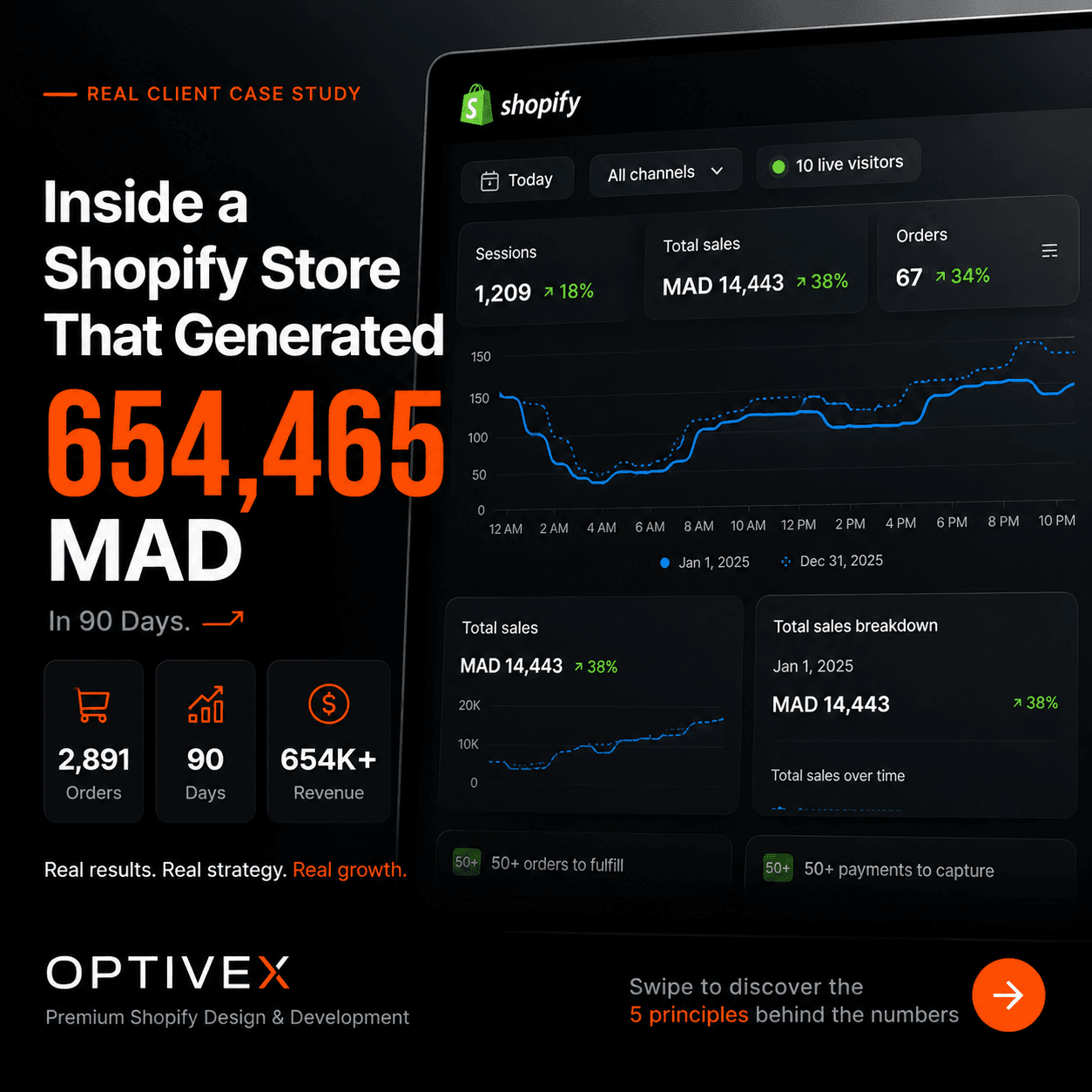
A Moroccan ecommerce brand moved from a primarily WhatsApp-based sales workflow to a structured Shopify store. Within the following 90-day period, its Shopify dashboard recorded 654,465.50 MAD in sales across 2,891 orders and 116,460 sessions.
This case study breaks down the ecommerce infrastructure OPTIVEX helped build, configure, and optimize around that transition. The client identity is withheld for confidentiality, and the results should be read as observed Shopify dashboard outcomes after the new operation launched, not as a guarantee or claim that OPTIVEX alone generated the sales.
Results snapshot
654,465.50 MAD
Shopify sales over 90 days
2,891
Orders
116,460
Sessions
48 Hours
Initial Shopify build
The Challenge: Selling Through WhatsApp Wasn't Built for Scale
WhatsApp can be useful for direct sales conversations, but a growing ecommerce brand eventually needs a more structured customer journey. When products, questions, order details, and follow-up all depend on messages, the workflow becomes harder to scale.
For growing Moroccan ecommerce brands, a structured storefront helps reduce product discovery friction, present products consistently, support higher order volume, track store behavior, measure advertising more clearly, and create room for upsell opportunities. These are operational reasons to move beyond message-based commerce as demand increases.
Why We Chose Shopify
Shopify made sense because the client needed scalable ecommerce infrastructure, not just a better-looking page. The platform gave the brand a structured way to manage products, create a mobile shopping experience, connect apps, review analytics, set up Meta tracking, and build SEO foundations.
For Moroccan ecommerce and Cash on Delivery-oriented workflows, Shopify is valuable when it is configured around how customers actually buy. This does not make WhatsApp, YouCan, or WooCommerce bad options; it means the brand had reached a stage where Shopify offered a stronger foundation for the next phase.
Building the Shopify Store in 48 Hours
Before implementation, OPTIVEX showed the client the theme and design direction so the visual foundation was clear. The client only needed to provide the original product images and assets.
OPTIVEX handled the ecommerce presentation and Shopify implementation: store structure, design setup, product presentation, image preparation, Shopify configuration, responsive behavior, mobile UX, and launch preparation. The initial store was completed in approximately 48 hours.
Speed did not mean publishing an unfinished template. The goal was to create a structured Shopify storefront that could receive real traffic, present products clearly, and support the brand's order flow.
Building the Ecommerce Infrastructure
After the core Shopify store was ready, OPTIVEX and the client discussed additional ecommerce functionality. The client agreed to integrations connected to upselling, checkout and order flow, and ecommerce optimization.
Upsell functionality
Upsell functionality helped the store present additional buying opportunities inside the customer journey. The point was not to add apps randomly, but to support a business workflow that could become more valuable as order volume increased.
Checkout and order-flow optimization
The order journey needed to feel clear on mobile and practical for Moroccan ecommerce behavior. OPTIVEX worked on the checkout and order-flow setup so customers had a more structured path from product interest to completed order.
Meta Pixel / advertising tracking
Meta and Facebook Pixel tracking were configured before the brand scaled advertising activity. This gave the Shopify operation a stronger measurement layer than a message-only selling workflow could provide.
SEO foundations
The Shopify setup included SEO foundations so products and core pages had a cleaner technical base. SEO was not presented as an immediate traffic guarantee; it was part of making the store more complete and easier to understand over time.
Mobile ecommerce optimization
Because Moroccan ecommerce demand often comes from social channels and mobile browsing, the store had to be comfortable on phones. Mobile optimization focused on product presentation, navigation, reading flow, and reducing friction around order actions.
The Launch
Once the store and tracking infrastructure were ready, the brand launched its advertising. The client initially reached approximately 60 orders per day, and as activity increased, stronger days approached approximately 100 orders.
The Shopify infrastructure gave the brand a structured destination for the demand its marketing was generating. It did not replace the need for strong products, advertising, operations, and customer handling.
The Results After 90 Days
Verified Shopify dashboard
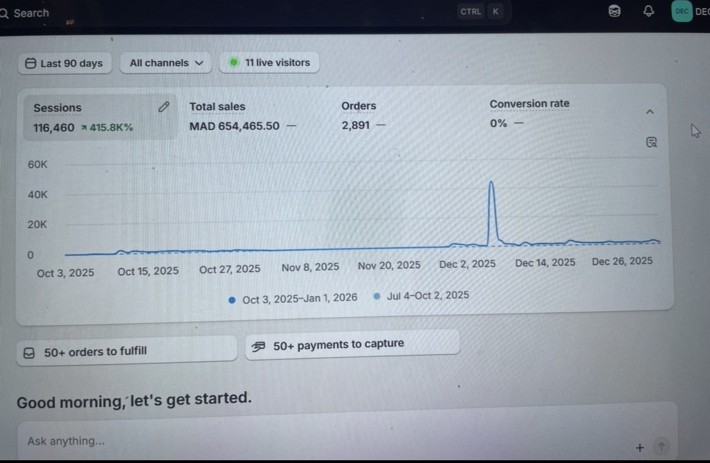
Over the displayed 90-day period, the Shopify dashboard recorded 654,465.50 MAD in sales, 2,891 orders, and 116,460 sessions. Operationally, those figures matter because they show the store was not just a brochure; it became the ecommerce destination receiving traffic and orders.
A Closer Look at the Growth
Verified Shopify dashboard
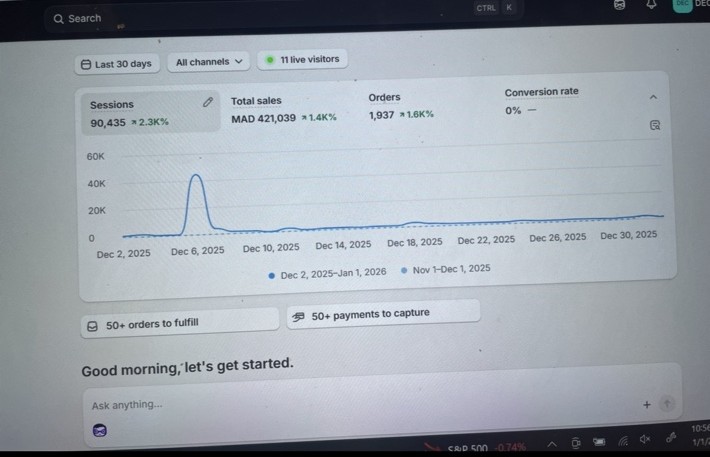
The 30-day dashboard view shows 421,039 MAD in sales, 1,937 orders, and 90,435 sessions. A substantial portion of the 90-day sales activity occurred during this 30-day period, though this article does not claim a single implementation change caused that concentration.
What One Week Looked Like
Verified Shopify dashboard
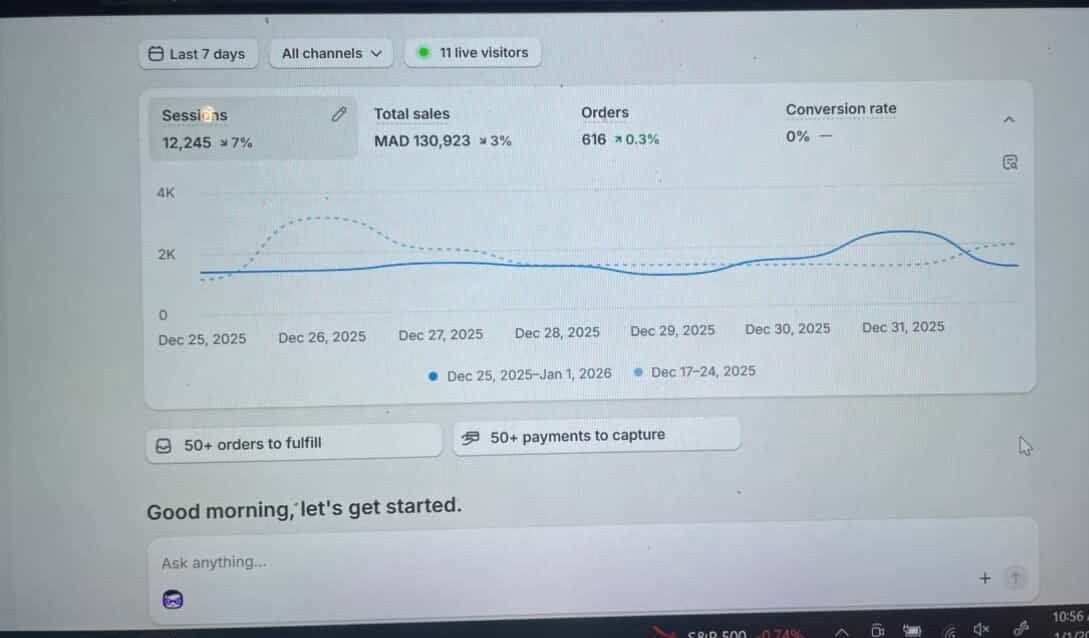
The 7-day view shows 130,923 MAD in sales, 616 orders, and 12,245 sessions. This view makes the operating scale more concrete: the Shopify store was handling meaningful demand over a short period, not only across a long reporting window.
What a Typical Active Day Could Look Like
Verified Shopify dashboard
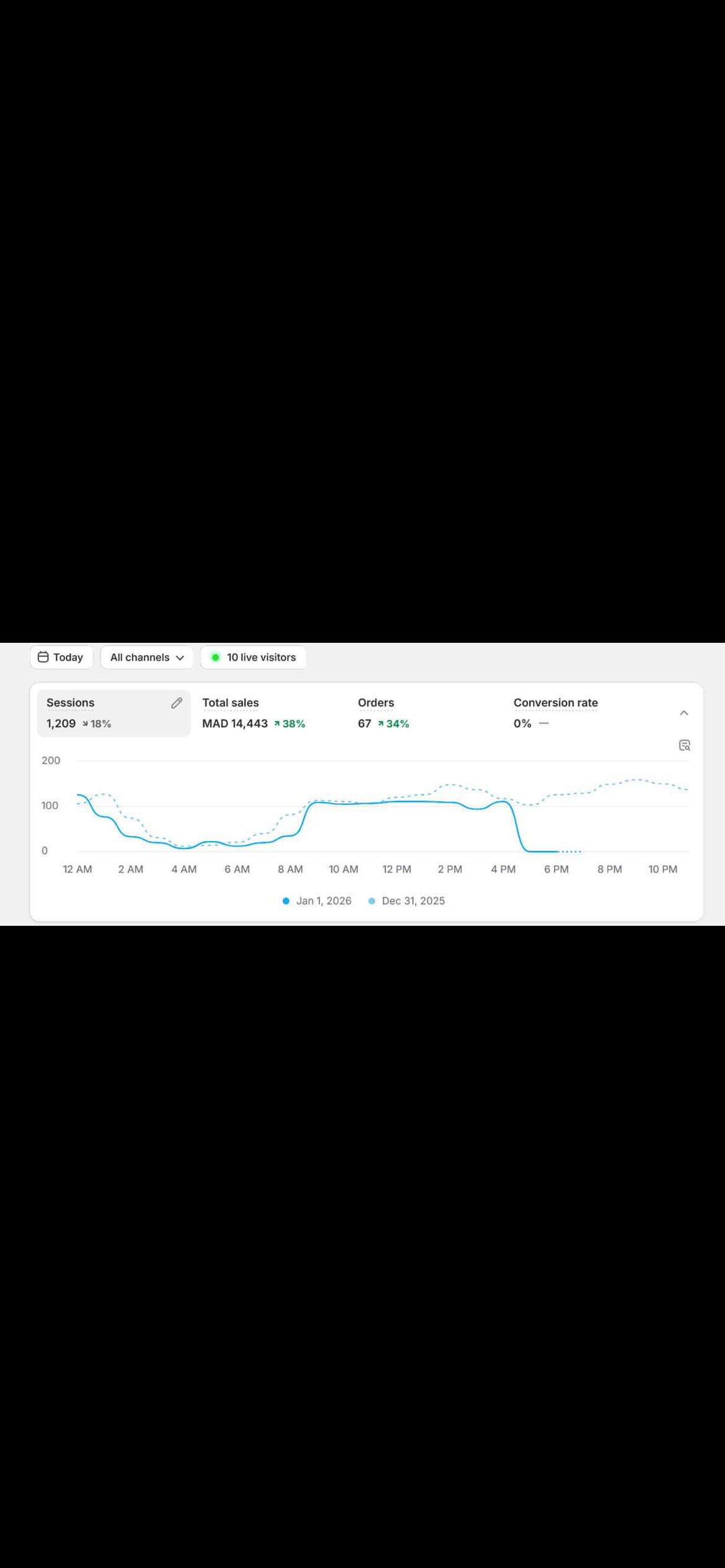
One daily snapshot shows 14,443 MAD in sales, 67 orders, and 1,209 sessions. Individual days varied, and this screenshot should be read as one active-day example rather than an average or guarantee.
What Actually Made the Difference?
There was no single magic theme, app, or setting. The transformation came from building a more complete ecommerce system around an existing Moroccan brand that already had demand.
- 01WhatsApp-first selling
- 02Structured Shopify storefront
- 03Stronger product presentation
- 04Ecommerce apps
- 05Optimized order journey
- 06Tracking setup
- 07SEO foundations
- 08Advertising traffic
- 09Iteration
What Moroccan Ecommerce Brands Can Learn From This
- Do not wait until operations become chaotic before building proper ecommerce infrastructure.
- Your store must support the traffic your advertising creates.
- Mobile UX matters heavily for social-driven ecommerce.
- Tracking infrastructure should be installed before scaling advertising.
- Shopify should be treated as infrastructure, not simply a website.
- Apps should solve actual business problems instead of being installed randomly.
Is Shopify Right for Your Moroccan Brand?
Shopify is suitable for Moroccan ecommerce brands that are already receiving consistent orders, selling through Instagram or WhatsApp, scaling Meta advertising, needing better analytics, or planning a more scalable ecommerce foundation.
It is not automatically necessary for every new seller. If a brand is still validating basic demand, a lighter workflow may be enough. But when order volume, advertising, product presentation, and tracking become serious, Shopify can become the operating layer that helps the brand manage the next stage.
Frequently Asked Questions
Is Shopify good for ecommerce in Morocco?
Yes, Shopify can be a strong ecommerce foundation for Moroccan brands that need a structured storefront, mobile shopping experience, analytics, and integrations. It is most useful when the brand already has demand or plans to scale beyond manual selling.
Can Moroccan brands use Shopify for Cash on Delivery?
Yes. Moroccan brands can use Shopify with Cash on Delivery workflows when the store, order flow, forms, apps, and operations are configured around local buying behavior.
When should a Moroccan brand move from WhatsApp to Shopify?
A brand should consider moving when product discovery, order handling, tracking, advertising measurement, or customer communication becomes difficult to scale through messages alone.
How much does a Shopify store cost in Morocco?
Pricing depends on scope, design depth, product setup, integrations, and whether the project is a launch, redesign, migration, or custom development build. You can review the current OPTIVEX Shopify pricing for package details.
Can OPTIVEX migrate an existing ecommerce store to Shopify?
Yes. OPTIVEX can support ecommerce moves to Shopify, including brands coming from WhatsApp-first selling, YouCan, WooCommerce, or an existing Shopify setup that needs restructuring.
Does Shopify work with Meta Ads in Morocco?
Shopify can work with Meta and Facebook Pixel tracking for Moroccan ecommerce brands. Tracking should be configured before advertising is scaled so the brand has a clearer view of store activity.
How long does it take to build a Shopify store?
A focused Shopify store can be built quickly when assets, products, scope, and decisions are ready. In this case study, the initial Shopify store was completed in approximately 48 hours before additional integrations and optimization work continued.
To compare service scope, review the current Shopify pricing. To explore design foundations, browse Shopify themes. To see more storefront work, visit Shopify projects or contact OPTIVEX to discuss a Shopify development project.
Shopify infrastructure for growing brands
Already generating orders and ready for a stronger Shopify infrastructure?
If your brand is growing through Instagram, WhatsApp, or paid advertising, OPTIVEX can help you build a Shopify store designed for the next stage of your ecommerce operation.